The story of the rights movement of young people in care — a hidden history of injustice and activism. Of young people, fresh from residential units, youth custody and foster homes, who came together to demand their voices be heard and to win change for everyone growing up in the care of the state.
The disadvantage faced by the care-experienced community should be the civil rights issue of our time.
Independent Review of Children’s Social Care, 2022
Origins: 1973–1979

The movement’s origins date to 1973, when young people in care first came together — through the Leeds Ad-Lib group, the first rights group of its kind in England — to talk about their lives, support one another and campaign against stigmatising policy and practice.
In 1975 the National Children’s Bureau launched the Who Cares? project, giving young people in care a national platform. Their words were published in 1977 as Who Cares? Young People in Care Speak Out. The project later became the charity Become, which continues today.
NAYPIC and the Children Act 1989
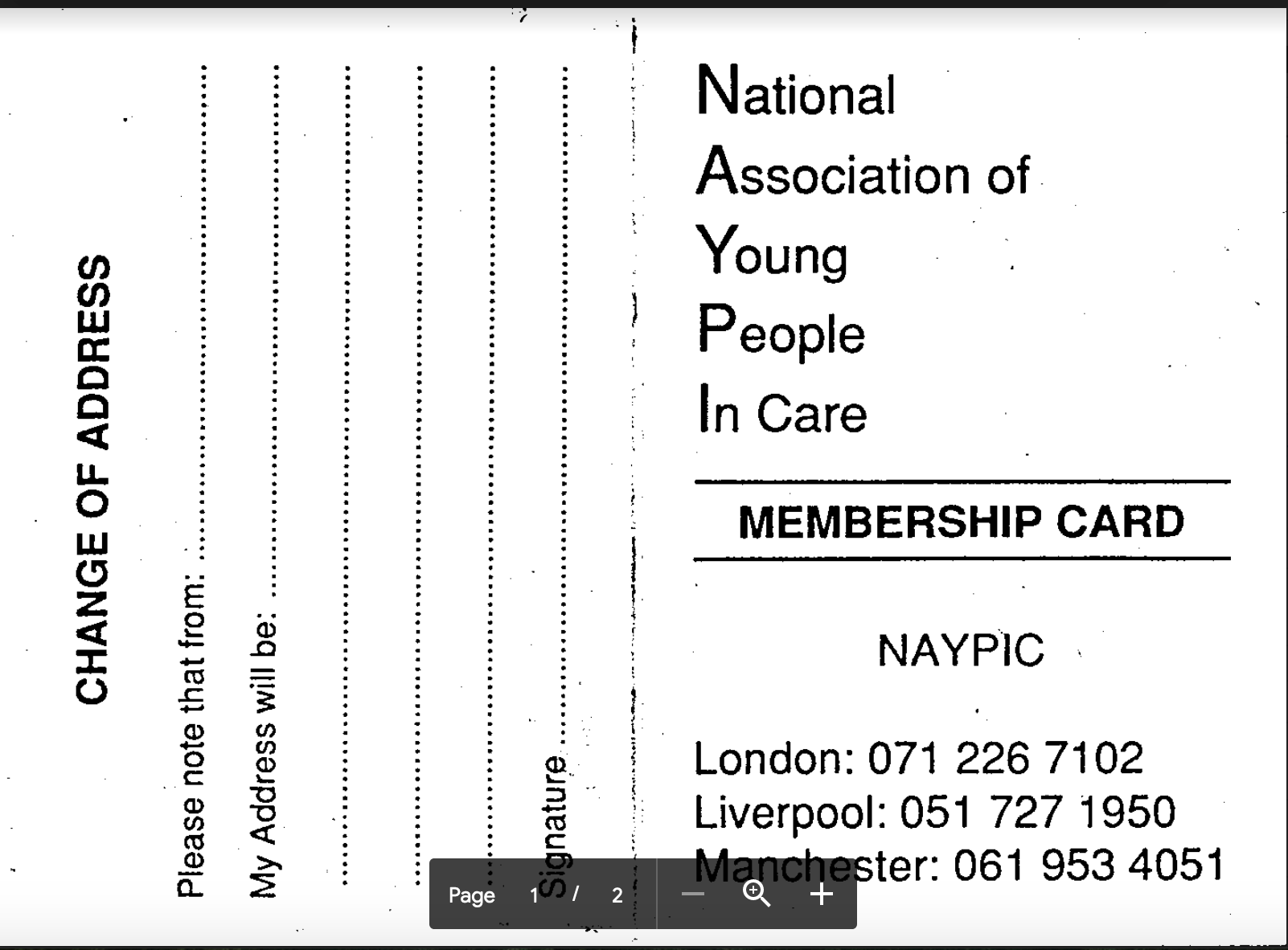
In 1979 the National Association of Young People In Care (NAYPIC) was founded — the first national organisation run for and by care-experienced people. Through local groups across the UK, a newsletter, weekly drop-ins and video and poetry workshops, it built a collective voice that government, social services and the media turned to.
In 1983 NAYPIC submitted Sharing Care — the first national collection of the views of young people in care — as written evidence to the House of Commons Social Services Select Committee. It raised, for the first time, the specific experiences of Black young people, young women and disabled young people in care, alongside files, reviews, fostering and leaving care.
In 1984 the Commons Committee’s report on Children in Care drew widely on that evidence, noting that “NAYPIC’s growth has given children a voice of their own.” Its recommendations shaped the Children Act 1989 — complaints procedures, stronger leaving-care duties, recognition of a child’s “racial origin, culture and language”, and the duty to ascertain children’s “wishes and feelings.”
A timeline of the movement
- 1973 — Leeds Ad-Lib group, the first rights group for young people in care in England.
- 1975 — the Who Cares? project (National Children’s Bureau); the book Young People in Care Speak Out follows in 1977.
- 1979–1994 — the National Association of Young People In Care (NAYPIC).
- 1983–1985 — Black and In Care.
- 1989 — the Children Act, shaped by the movement’s evidence.
- 1999 — A National Voice (becomes part of Coram Voice in 2017).
- 2000 — the Care Leavers Association.
- 2010 — Siblings Together.
- 2013 — Every Child Leaving Care Matters.
- 2019 — the Care Experienced Conference, Liverpool Hope University.
- 2020 — the Black Care Experience; “Our Care, Our Say”.
- 2021 — RECLAIM.
- 2022 — the Care Experienced Movement; the Independent Review of Children’s Social Care.
Black and In Care
Between 1983 and 1985 the Black and In Care group documented institutional racism in the care system — at a time when children from Black and minority-ethnic communities routinely had their identities, heritage and even their names taken from them. The 1983 Black and In Care film, the first made by and with young people in care, led to the first Black and In Care conference in 1984 and helped shift transracial fostering policy across the major children’s organisations.
Where the movement is today
Social media has drawn a wider, intergenerational community together under the banner #CEP, and the Care Experienced Conference in 2019 marked a visible resurgence. In 2022 the Independent Review of Children’s Social Care called the disadvantage faced by care-experienced people the civil rights issue of our time. Campaigns continue — to have care experience recognised as a protected characteristic, and to record and honour the movement’s own history.
Care-experienced activism belongs alongside the histories of the women’s movement, gay rights and disability rights — grassroots movements in which a marginalised community organised to articulate its own demands. As Professor Mike Stein, who chronicled this history in Care Less Lives (2011), has shown, it was the movement’s campaigns, surveys and evidence to Parliament that led to the views of young people in care being recognised in law, policy and practice. Every movement needs to chart its own history — and this one is finally being written.

